How to Measure and Track Visibility on Generative Search Engines
How do generative-first marketing teams set goals? About the "North Star" metrics in the world of Generative Search.


Measure what matters. It's nearly impossible to make progress without a metric. If you're a marketer looking to increase your brand's visibility on generative engines like ChatGPT and Perplexity, how do you know where you stand?
In the world of SEO, we use Domain Authority to track at a high level our website's performance on Google Search. We see this score - on our SEMRush dashboard - as an aggregate indicator of visibility across our different web properties, including branded home pages, high-conversion landing pages, and blog content. Domain Authority moves very slowly over quarters and years, so it's not a noisy target.
For GEO, there is no established metric like Domain Authority for a brand's visibility on search engines. Here are some reasons why GEO is a harder metric to track than SEO:
- Showing up is not the same as a recommendation: On Search, marketers track their ranking for key queries.
- Attribution: On Google Search Console, marketers can see impressions and clicks to site. However, when your brand is mentioned in a generative answer, they may not always click through directly to your website. So, attribution becomes more difficult. This also makes it difficult to verify GEO tracking tools as you can't match the numbers to first-party traffic results.
- Branded vs not: People certainly ask ChatGPT for information about a brand. They might ask questions like "Kapwing vs Canva for video editing". In SEO, branded search is often handled differently than non-branded search as it indicates how familiar the user is already with your brand.
- Ranking: Marketers know that leads are more likely to click on results that appear closer to the top. Similarly, when an LLM mentions several products, the one that shows up first in the answer is most likely to attract buyers. How do you measure
Winning > participating (or what's wrong with GEO metrics)
— Pierre-Alex (@pierrealexai) December 9, 2025
Here’s the user prompt:
“What's the best worker's compensation insurance for my manufacturing company? The company is located in Texas and employ 500 assembly line workers”
Now, look at the ChatGPT answer in the… pic.twitter.com/05Y5hL8eKJ
The Core Metrics of Generative Visibility
In generative search, success is defined by how LLMs chose, cite, and summarize your product or service. Focus on these three core GEO metrics:
- Citation Frequency or Mention Rate: The percentage of sampled AI-generated answers in your domain that reference or explicitly cite your brand, domain, or a piece of your content.
- Attributed referrals: Trackable clicks and conversions coming directly from AI-generated answers.
- Brand prominence and quality: A composite score measuring how your brand appears (e.g., is it in the first sentence? Is it the sole source? Is the sentiment positive?).
In a sense, GEO is a mix of how brands monitor on social media (perception and sentiment) and on search. Before the industry has settled on one metric, companies must come up with their own aggregations to use as a GEO North Star.
GEO Requires Monitoring Multiple Platforms
While SEO is dominated by Google Search, GEO requires cross-platform monitoring. Each Large Language Model (LLM) has a different training cut-off, real-time data integration, and underlying knowledge base, meaning your brand has a different presence in each of the leading models:
- Google AI Overviews (SGE/GAO): Focuses on highly trustworthy, authoritative, and fact-dense content. Optimizing for this often aligns with strong traditional SEO signals like E-E-A-T (Experience, Expertise, Authoritativeness, and Trustworthiness).
- ChatGPT, Claude, Gemini: These conversational assistants require content that is easily digestible, concise, and structured for direct Q&A extraction.
- Perplexity: Highly focused on providing verifiable sources, making citation frequency a paramount metric for this platform.
Tools for Tracking Generative Visibility
At Kapwing, we've tried out a few tools for monitoring visibility. Below are my impressions of each one.
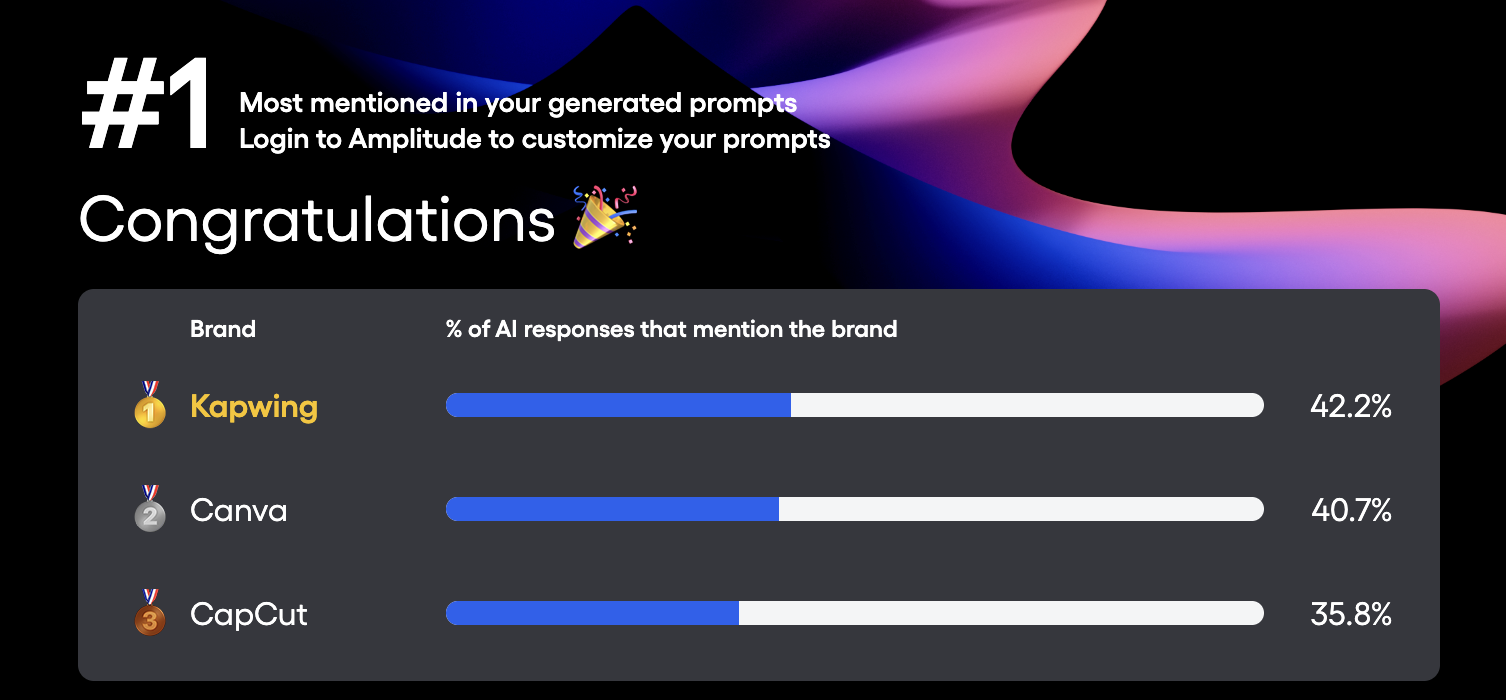
Best Free Tool: Amplitude's AI Visibility
Amplitude recently launched a free GEO visibility tracker. This web app is a great place to start if you're a brand wondering how you compare to competitors in generative search engines. The Amplitude report includes a list of prompts for which your brand has visibility, comparison matrices to top competitors, and sources for LLM answers.
Trakkr also provide a free tool for GEO analysis. Input your brand, and it will generate a free report for you.
SEMRush's AI Visibility Toolkit: All-in-One Suite
We're SEMRush customers, so I was disappointed that I needed to pay an extra $99 subscription fee to access the AI Visibility Toolkit. The subscription does get you a top-line score, volume numbers, and tracking over time. Through the AI Visibility Report, you can see your quantitative comparison to competitors.
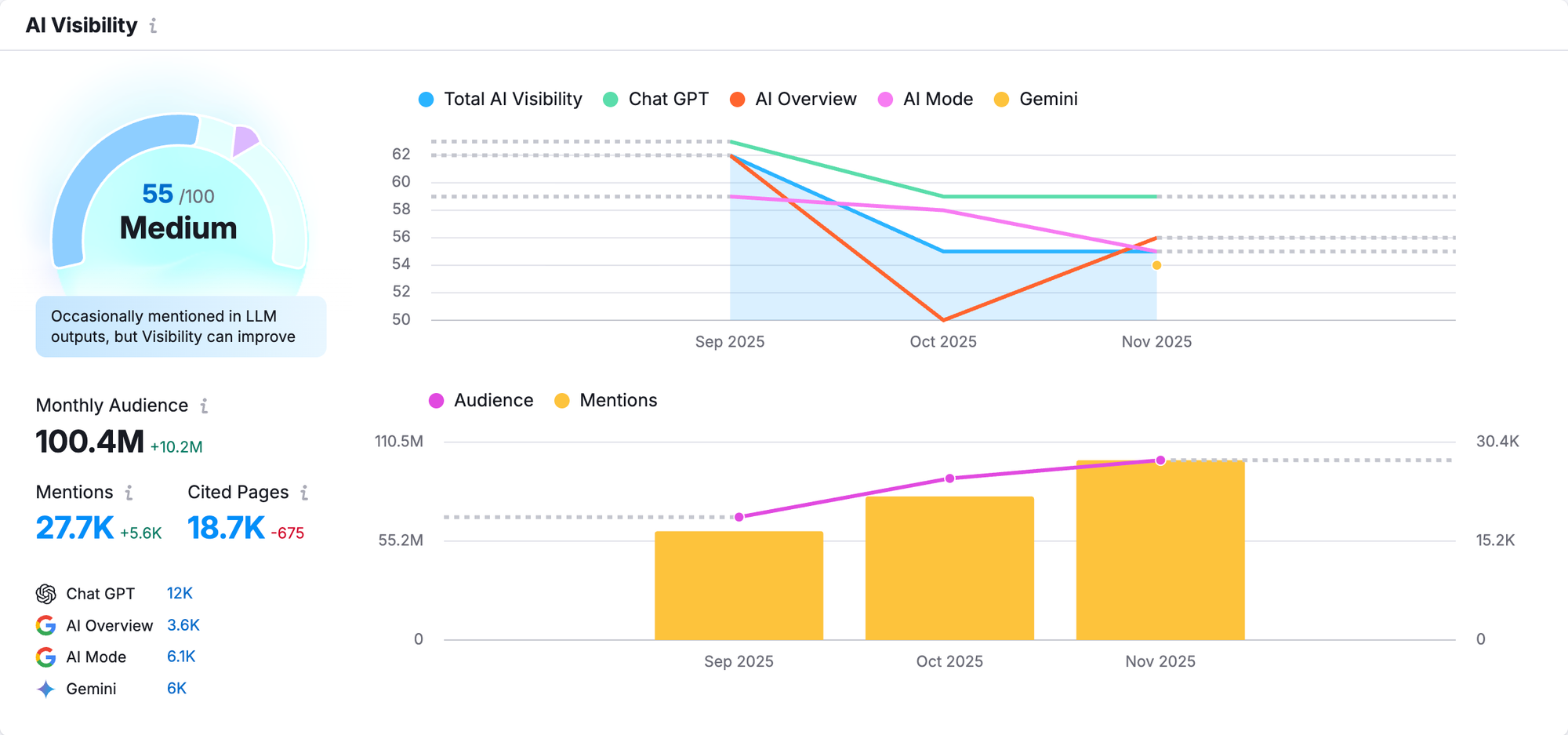
SEMRush is working on a "Growth Actions" tab, coming soon.
Google Analytics: Tracking Direct Referrals
Despite belonging to the same company, Google Analytics does not have any first-party metrics related to AI Overviews or visibility on Gemini. Impressions and clicks from AI Overviews are silently included in GA4 metrics, although this is impossible to verify.
To see your referral traffic from ChatGPT and other chatbots, follow these instructions. These will show you the number of direct clicks that arrive on your website from a chatbot citation or link.
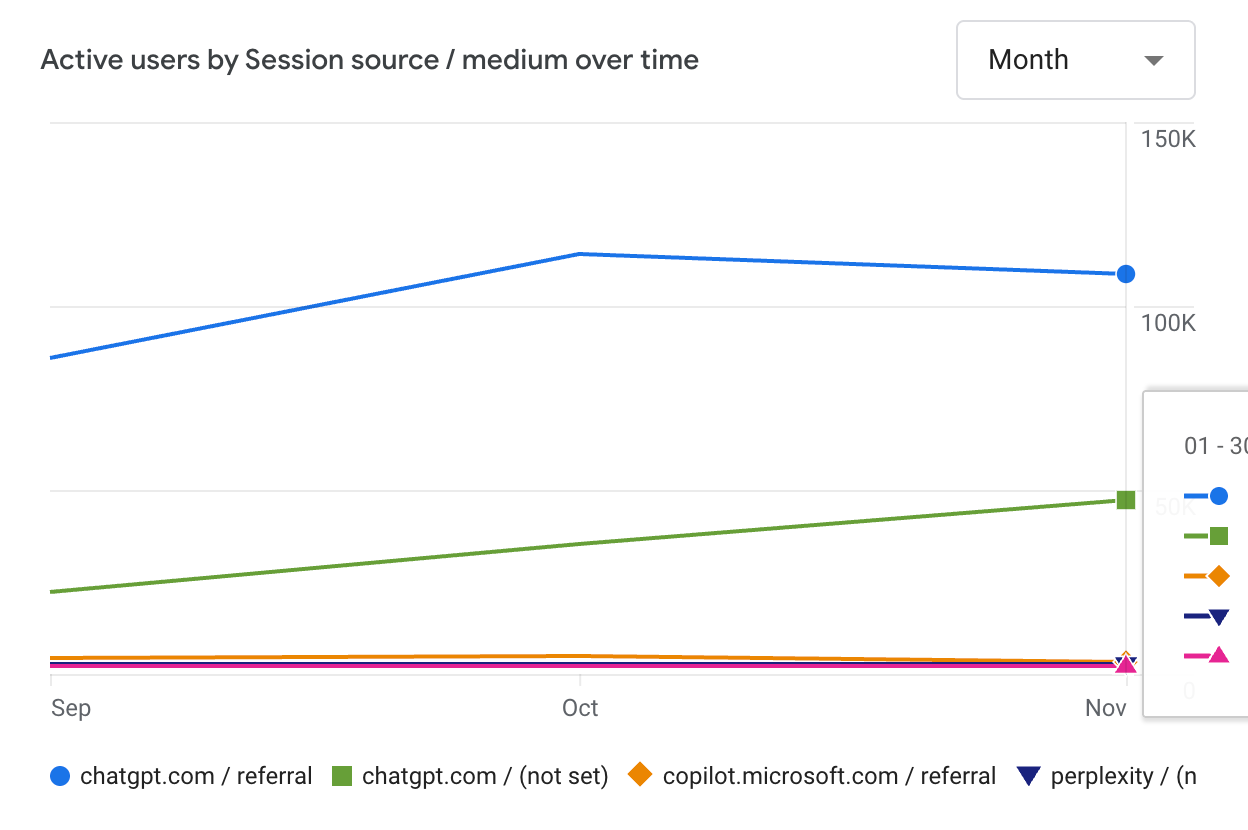
On Kapwing, for example, ChatGPT is by far our leading referral source. According to direct referrals, we get about twice as many unique users referred to our website from OpenAI's chatbot than from others. We have more visibility on Perplexity and Copilot than on Gemini.
Strategy: Linking Visibility to Outcomes
Visibility is meaningless without impact. The ultimate goal of GEO tracking is to connect your AI mentions to pipeline and revenue.
Prompt-Based Research
Optimizing for natural language prompts and questions follows naturally from good journalism and a focus on search intent. Rather than stuffing for keywords, focus on answering natural language questions with these strategies:
- Identify Core Prompts: Map the specific questions your target audience asks at each stage of the buyer journey (e.g., "What is the best CRM software for small business?" or "How to measure GEO success?").
- Benchmark: Manually or use a tool to run these prompts across platforms to capture your initial Citation Frequency and AI Share of Voice.
- Optimize: Tune your content to provide a concise, factual, and well-structured answer to that prompt, increasing its extractability.
Incorporate new language
Understand industry terms before they're popular and incorporate them into your content marketing, or champion a brand term to own its meaning. Since LLMs are language predictors, using domain lingo will help LLMs recognize your brand as a domain expert when people include those words in their prompts.
Optimizing for Extractability
Generative models prefer content that is easy to summarize and attribute.
- Structure for Scannability: Use clear H2/H3 headings, bulleted lists, and tables. Start content sections with a direct, one-sentence answer to the query.
- Implement Schema Markup: Use structured data (e.g., FAQ Schema, How-To Schema, Organization Schema) to explicitly guide AI models on the context and structure of your information.
- Reinforce E-E-A-T: Ensure content is created by a clear expert, well-cited, and demonstrates real-world experience. We've started including statistics in articles to enhance the discoverability of our content on generative search engines
Increase Content Volume
Since AI companies consume the web faster and more frequently than Google search crawlers, new articles and content will help your brand rise to the top. How do you put more words onto the internet at a faster pace?
- Respond to online reviews and comments: Head to Google My Business or YouTube to find opportunities to comment and write about your brand, emphasizing key language that will show up in prompts.
- Make and post videos: Long-form YouTube videos, interviews, and podcasts can be a great way to get more words out there onto the internet. Kapwing's AI Video Generator is the fastest way to make multi-scene narrative videos from a prompt.
- Incentivize UGC: Consider reward programs for customers and fans who leave good reviews, write blog posts, or post videos about your business. These will help LLMs learn positive sentiment about your business or product.
Conclusion
The shift to generative search is not a temporary trend; it’s a new paradigm for content discovery. By adopting Generative Engine Optimization (GEO) metrics like Citation Frequency and AI Share of Voice, and leveraging specialized tracking tools, brands can move beyond the old limits of keyword rankings. Success in the AI era means prioritizing clarity, authority, and providing content that is designed to be the definitive answer, not just a link on a page.
Julia Enthoven is the cofounder and CEO of Kapwing, an AI Video Editor for generative-first marketing teams. She's a top thought leader on SEO and GEO (Generative Engine Optimization) and runs the blog Generative Visibility.